


eDNA Christmas Island: What Can Seawater Tell Us About Marine Life?
Updated: Jul 21
When you go diving on Christmas Island, you see only a small part of the incredible marine environment surrounding the island.
A reef shark glides past. A turtle disappears into the blue. A school of fish moves across the reef. A tiny goby hides in a crack in the rocks.
But what if scientists could detect evidence of marine life without necessarily seeing the animals themselves?
That is where environmental DNA — or eDNA — comes in.
Recent eDNA sampling around Christmas Island is helping scientists learn more about the marine life found in the waters surrounding this remote Indian Ocean island.
What is environmental DNA (eDNA)?
Every living thing leaves behind tiny traces of genetic material in the environment.
Fish, sharks, turtles, corals and other marine organisms can release DNA into the water through skin cells, scales, mucus, waste and other biological material.
Scientists can collect seawater and filter it to capture these tiny genetic traces.
In the laboratory, scientists analyse particular sections of the DNA. These sequences can act like genetic barcodes, which can then be compared with reference databases to identify the organisms they most closely match.
In simple terms, eDNA can provide clues about the marine life whose genetic material is present in a sample of seawater.
More than 90 seawater samples collected around Christmas Island
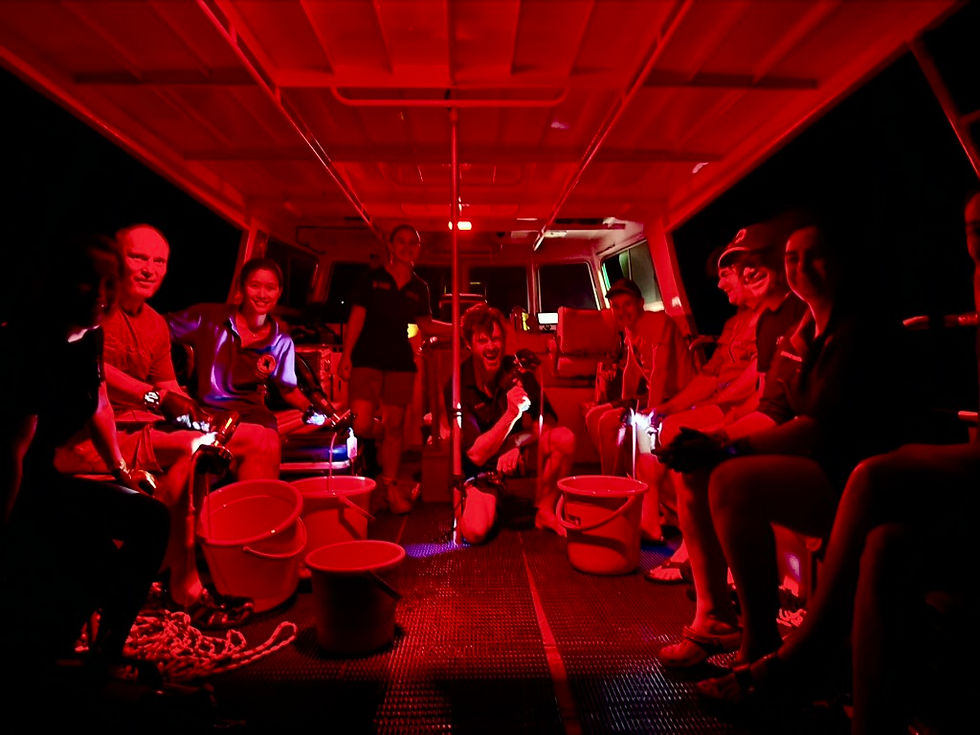
Last week, the Extra Divers team joined scientists and community members on the water around Christmas Island to help collect more than 90 seawater samples for eDNA research.
Over several days, samples were collected from different locations around the island.
Each sample contains seawater that may contain tiny traces of DNA from marine organisms in the surrounding environment.
The samples will now be analysed in the laboratory over the coming weeks.
We will have to wait to find out exactly what the results reveal.
What species will be detected?
Will the samples provide evidence of animals that are rarely seen by divers? Will they reveal DNA from species that are difficult to study using traditional survey methods?
That is the exciting part.
For now, the samples are on their way to the lab. In the coming weeks and months, they may help build an even better picture of the incredible marine biodiversity around Christmas Island.

Why is eDNA important for marine research?
Traditional marine surveys are incredibly valuable.
Divers, researchers and underwater cameras can record what they see, while other scientific methods can provide information about animal numbers, behaviour and habitats.
But the ocean is enormous.
Many species are difficult to see, are active at different times of day, live in deep water or may simply not be encountered during a particular survey.
eDNA provides another way to study marine ecosystems.
A relatively small water sample can contain genetic information from a wide range of marine organisms. In the broader Minderoo Foundation and Parks Australia eDNA dataset, each two-litre seawater sample produced an average of 62 marine species detections.
That is a remarkable amount of information from a small amount of water.
It is important to remember, however, that eDNA is a complementary tool. It does not replace traditional surveys, diving observations or other scientific methods. Instead, it adds another layer of information to help scientists understand marine biodiversity.
Understanding Christmas Island's marine environment
Christmas Island is surrounded by a unique and incredibly diverse marine environment.
Located in the Indian Ocean, far from mainland Australia, the island's surrounding waters support a remarkable variety of marine life.
The reefs and waters around Christmas Island are home to sharks, turtles, rays, tuna, reef fish, corals and countless other marine organisms.
For divers, this is what makes Christmas Island diving so special. Every dive can reveal something different.
Research using eDNA provides another way to understand the marine life whose DNA can be detected in these remote waters.
This is particularly important for places like Christmas Island, where the surrounding ocean is vast, remote and not always easy to survey.
The more information scientists can gather about marine biodiversity, the better they can understand how species are distributed and how marine ecosystems may change over time.
Does eDNA replace diving?
Absolutely not.
There is no substitute for getting in the water.
A positive eDNA detection can provide evidence that DNA from a species was present in a sample, but it does not tell us exactly how many animals were present or provide the same information as seeing the animal, observing its behaviour or understanding the habitat where it lives.
For divers, this is part of what makes the ocean so fascinating.
Every dive is an opportunity to see something new.
Every survey method provides a different piece of the puzzle.
eDNA is another tool — one that can help scientists detect marine life that may otherwise go unnoticed.

Listening to the ocean
For generations, scientists have studied the ocean by looking, counting, photographing and observing.
Now, they can also collect and analyse the genetic traces left behind in the environment by the animals and other organisms themselves.
It is a fascinating example of how technology is helping us understand the underwater world.
The next time you are floating above a reef while diving Christmas Island, remember that the water around you is full of information.
Every fish, turtle, shark and other marine organism may be contributing tiny genetic traces to the surrounding environment.
The ocean is, in a way, constantly providing clues about what is there.
We are only getting better at reading them.
The story is only just beginning
Last week, more than 90 seawater samples were collected around Christmas Island.
Now, the waiting begins.
As the samples are analysed in the laboratory, they may provide evidence of marine life that we see regularly, species that are rarely observed, or perhaps even some surprises.
For those of us who spend time underwater, the results will be fascinating.
Every dive gives us a glimpse of the marine environment.
eDNA may give scientists another way to understand the biodiversity of the ocean around Christmas Island — including organisms that we may never see during a dive.
The ocean is constantly providing clues about what is there.
We are only getting better at listening.
Find out more about eDNA and marine research


** please check all scientific references with published data


Comments